Red Spot II
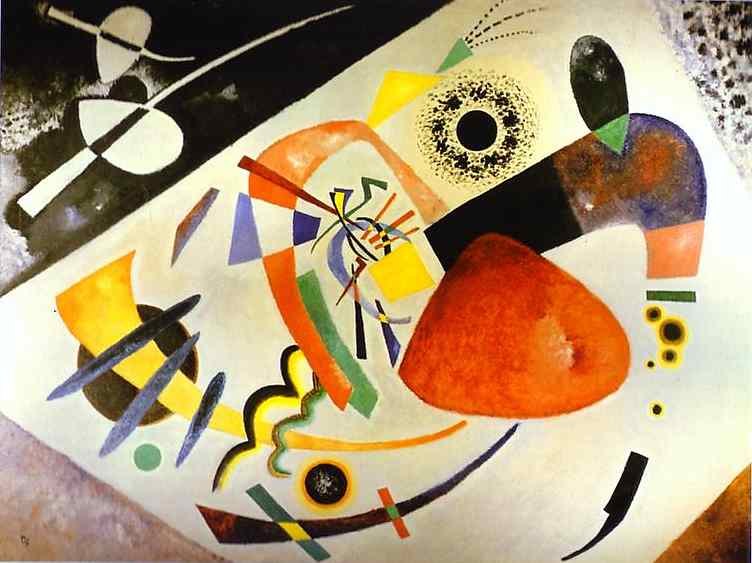
Kandinsky floats a large red-orange shape, arcs, blades and small circles across a tilted white plane set against darker corners.
A tilted, pale four-sided plane fills most of the canvas, angled like a tabletop seen from above, with darker, mottled corners showing around it. On this surface Kandinsky scatters a lively cast of forms: a large rounded red-orange mass at center right, a black circle ringed with dots near the top, a yellow crescent, slender blue-gray blades at left and tiny yellow and black discs at right. Thin lines and wedges cluster near the middle like a small burst.
Around 1921 Kandinsky was moving away from the stormy, free-flowing abstraction of his prewar years toward clearer, more geometric shapes. This picture sits right at that turning point: some forms still have soft, painterly edges, while others are crisp triangles and rings. He believed colors and shapes carried their own inner sounds, and the red mass here works like a loud, sustained note set against quieter accompaniment.
Anchor the diagonal plane first, then place the red spot just right of center. The dotted black ring near the top and the dark oval at upper right help lock everything in place.
More by Wassily Kandinsky
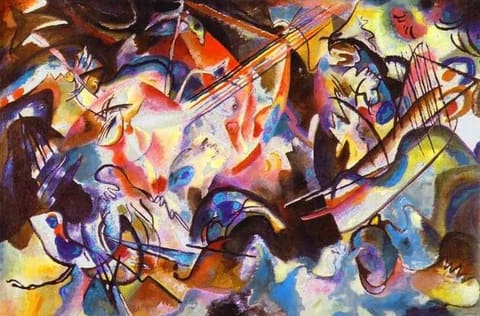 Composition VISwirling masses of color collide across Kandinsky's large Composition VI, an abstract storm he connected with the theme of the biblical Flood.
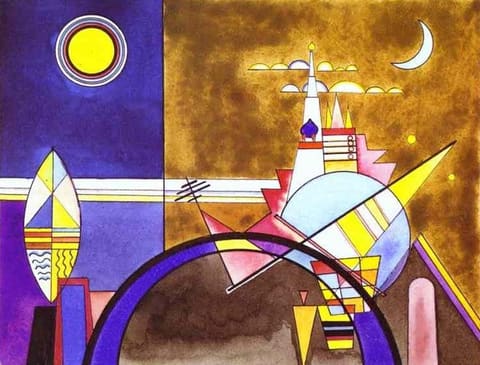 The Great Gate of KievA full yellow sun, a crescent moon and a pink-and-white tower crowd this bright watercolor design built from arcs, wedges and stripes.
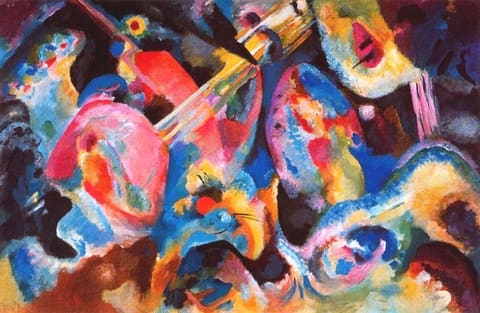 Improvisation DelugeSwirling masses of pink, blue and yellow collide across a dark ground in Kandinsky's abstract meditation on the theme of the flood.
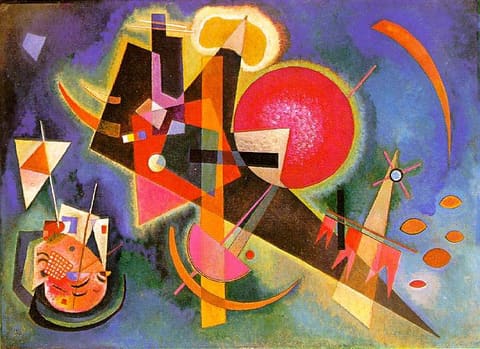 In BlueTriangles, circles and crescents float against a deep blue field in Kandinsky's crisp, geometric abstraction from his Bauhaus years.
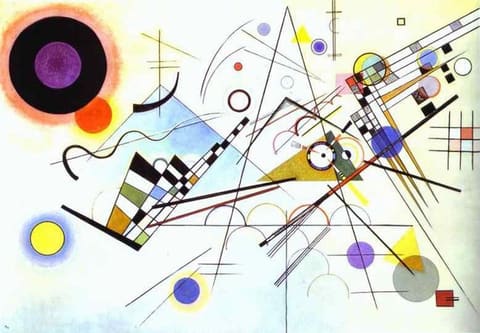 Composition VIIIKandinsky's crisp abstraction scatters circles, triangles, checkerboards and fine lines across a pale ground, anchored by a large black circle at upper left.