Composition VI
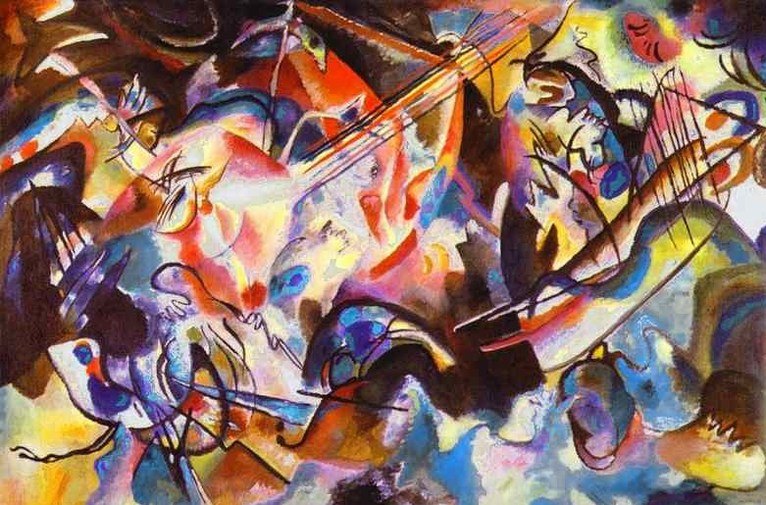
Swirling masses of color collide across Kandinsky's large Composition VI, an abstract storm he connected with the theme of the biblical Flood.
At first glance the canvas is pure turbulence: clouds of pink, violet, blue and yellow wash into one another, crossed by sharp black lines, hooks and tangled scribbles. Look longer and two main centers emerge, a softer, glowing area on the left and a harder, more agitated cluster on the right, linked by bundles of parallel lines that sweep diagonally toward the top.
Kandinsky reserved the title Composition for his most ambitious paintings, and he finished this one in 1913, only a few years after his decisive move toward abstraction. He linked it to the idea of a great flood, yet he wanted it to express destruction and renewal through color and line alone, with no recognizable ark or waves. Like music, it aims to move the viewer directly rather than tell a story.
It belongs to a remarkable run of works he produced in Munich just before the First World War. To recreate it, note the dark brown shapes along the left and lower edges, the pale yellow-white zone near the center, and the striped band that slants across the upper middle.
More by Wassily Kandinsky
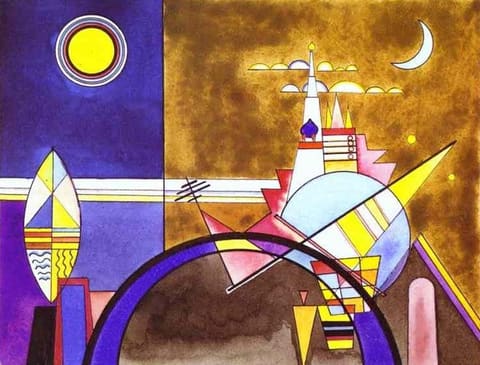 The Great Gate of KievA full yellow sun, a crescent moon and a pink-and-white tower crowd this bright watercolor design built from arcs, wedges and stripes.
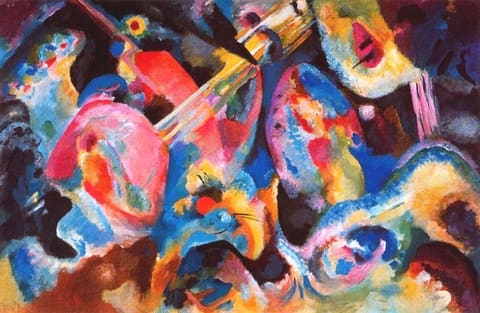 Improvisation DelugeSwirling masses of pink, blue and yellow collide across a dark ground in Kandinsky's abstract meditation on the theme of the flood.
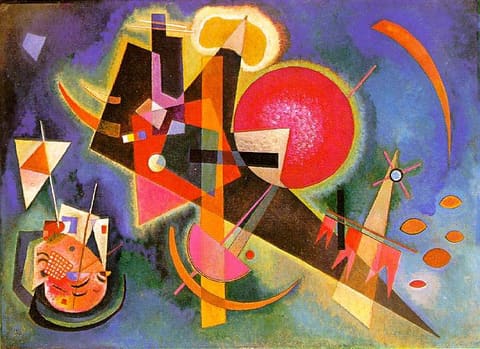 In BlueTriangles, circles and crescents float against a deep blue field in Kandinsky's crisp, geometric abstraction from his Bauhaus years.
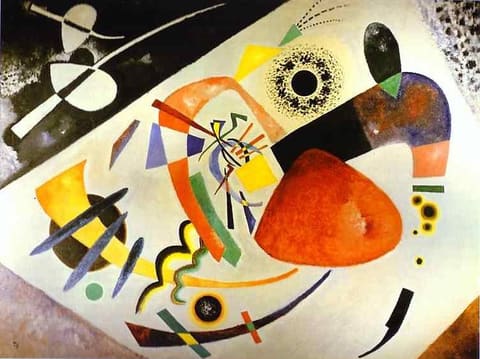 Red Spot IIKandinsky floats a large red-orange shape, arcs, blades and small circles across a tilted white plane set against darker corners.
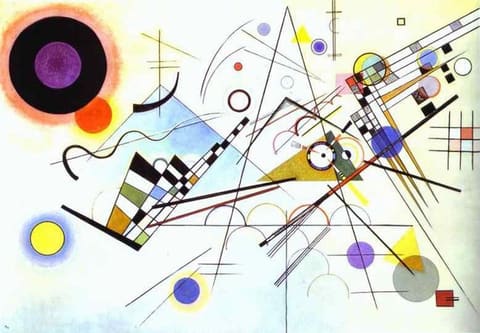 Composition VIIIKandinsky's crisp abstraction scatters circles, triangles, checkerboards and fine lines across a pale ground, anchored by a large black circle at upper left.