Improvisation Deluge
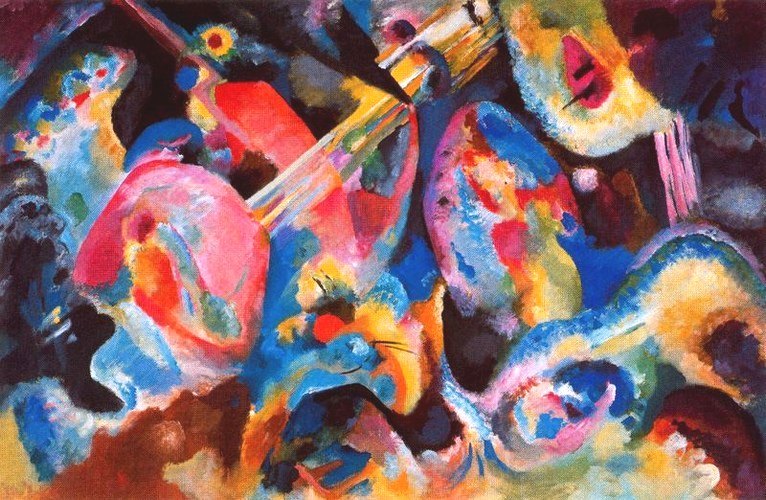
Swirling masses of pink, blue and yellow collide across a dark ground in Kandinsky's abstract meditation on the theme of the flood.
There is no horizon here and no single focal point. Rounded, cloudlike forms in hot pink, red and ultramarine crowd the surface, edged with dark outlines and broken up by smaller flecks of yellow, green and white. A long diagonal band, striped in pale gold and pink, slices from the upper center toward the lower left, and wavy shapes along the bottom suggest churning water.
Kandinsky used the word Improvisation for pictures that grew from inner impulse rather than from careful planning. In 1913 he was preoccupied with the biblical flood as an image of destruction and renewal, and this canvas is closely related to his large Composition VI, painted the same year. Traces of real objects, such as boats or oars, survive only as hints within the turbulence.
This was the moment he moved decisively toward full abstraction, letting color carry feeling the way music does. To memorize the layout, anchor yourself on the large pink oval left of center and the blue-and-yellow wave curling in from the right.
More by Wassily Kandinsky
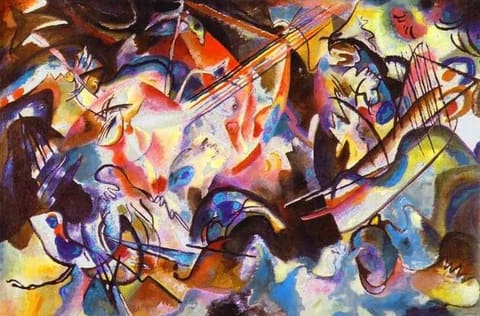 Composition VISwirling masses of color collide across Kandinsky's large Composition VI, an abstract storm he connected with the theme of the biblical Flood.
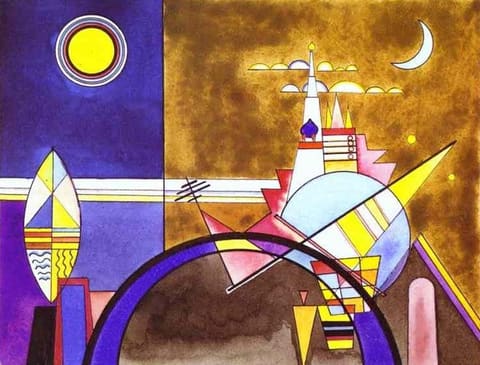 The Great Gate of KievA full yellow sun, a crescent moon and a pink-and-white tower crowd this bright watercolor design built from arcs, wedges and stripes.
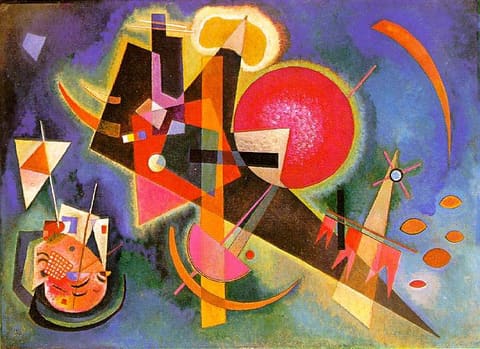 In BlueTriangles, circles and crescents float against a deep blue field in Kandinsky's crisp, geometric abstraction from his Bauhaus years.
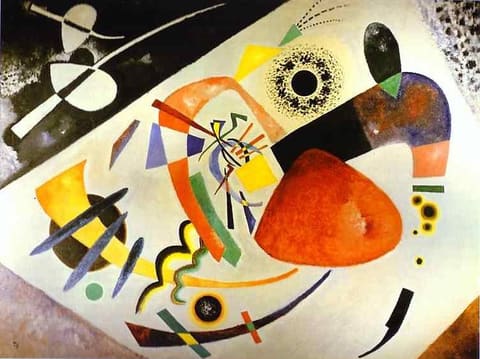 Red Spot IIKandinsky floats a large red-orange shape, arcs, blades and small circles across a tilted white plane set against darker corners.
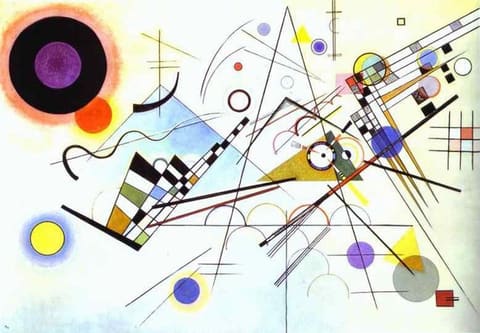 Composition VIIIKandinsky's crisp abstraction scatters circles, triangles, checkerboards and fine lines across a pale ground, anchored by a large black circle at upper left.