In Blue
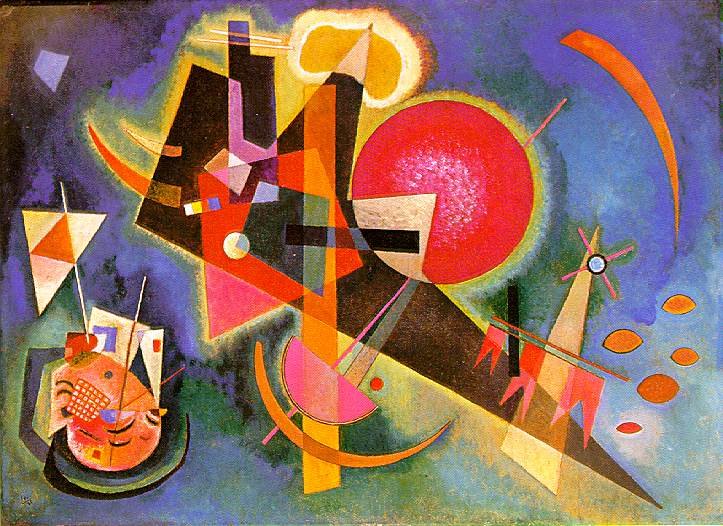
Triangles, circles and crescents float against a deep blue field in Kandinsky's crisp, geometric abstraction from his Bauhaus years.
Against a mottled ground of deep blue and violet, a large dark triangle rises diagonally from the lower right toward the top center, overlapped by translucent planes of pink, orange and yellow. A glowing red-pink circle sits just right of center, and thin lines, crescents and small oval shapes are scattered around the edges. At lower left, a cluster of forms resembles a small boat or a decorated figure, though it stays open to interpretation.
Kandinsky taught at the Bauhaus from 1922, and his painting in those years became more geometric and controlled than the turbulent canvases of the early 1910s. He studied the effects of basic shapes and colors, believing each carried its own emotional charge, and he set out these ideas in his 1926 book Point and Line to Plane.
Many shapes glow with a soft halo against the blue, which makes them seem to hover. When reproducing this composition, start with the big black triangle and the red circle, then add the orange crescent at upper right and the pointed figure on the right with its spiky pink legs.
More by Wassily Kandinsky
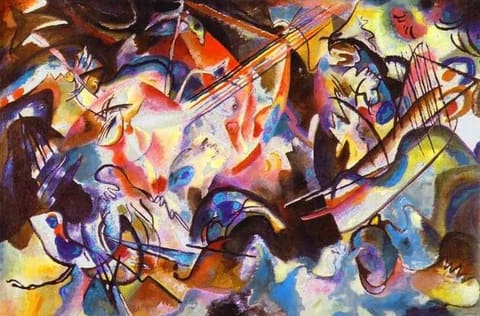 Composition VISwirling masses of color collide across Kandinsky's large Composition VI, an abstract storm he connected with the theme of the biblical Flood.
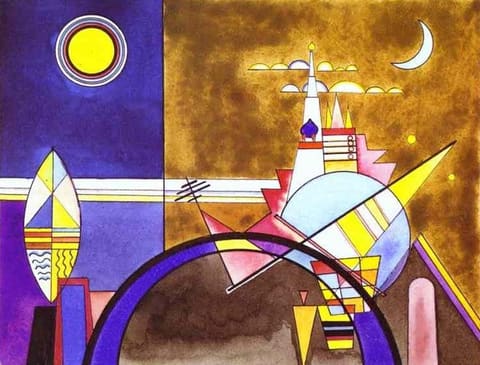 The Great Gate of KievA full yellow sun, a crescent moon and a pink-and-white tower crowd this bright watercolor design built from arcs, wedges and stripes.
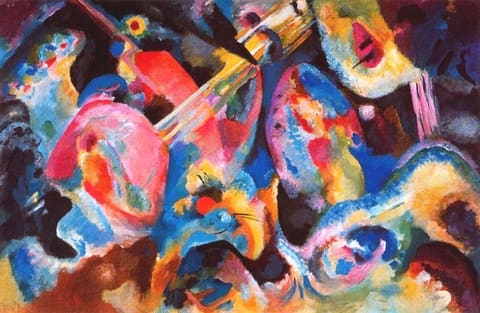 Improvisation DelugeSwirling masses of pink, blue and yellow collide across a dark ground in Kandinsky's abstract meditation on the theme of the flood.
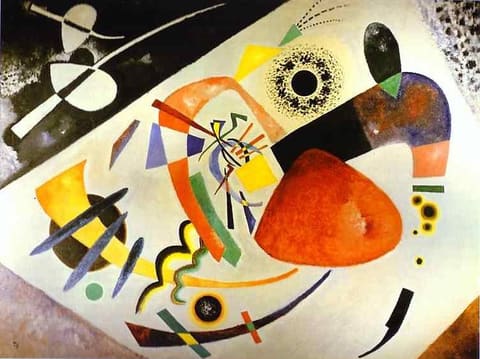 Red Spot IIKandinsky floats a large red-orange shape, arcs, blades and small circles across a tilted white plane set against darker corners.
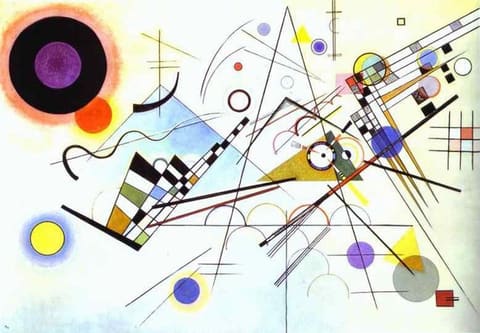 Composition VIIIKandinsky's crisp abstraction scatters circles, triangles, checkerboards and fine lines across a pale ground, anchored by a large black circle at upper left.