Composition VIII
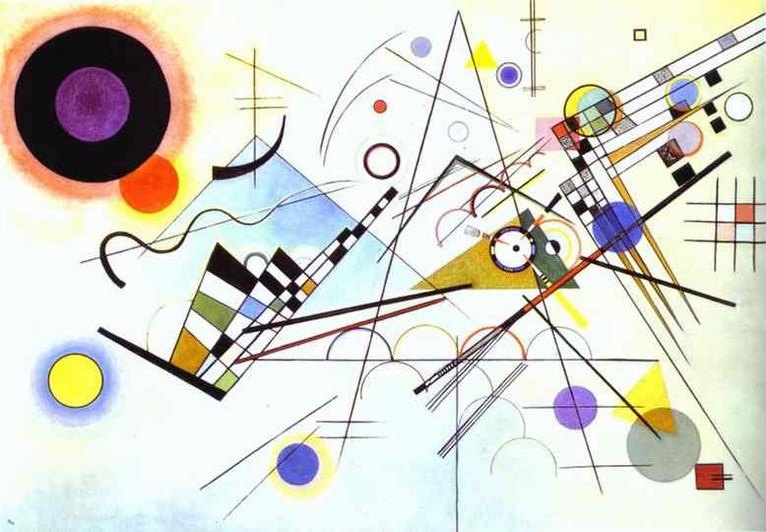
Kandinsky's crisp abstraction scatters circles, triangles, checkerboards and fine lines across a pale ground, anchored by a large black circle at upper left.
On a cream background, Kandinsky arranges dozens of precise elements. A big black circle with a violet center and a red-orange halo dominates the upper left corner. From there the eye moves to a tall thin triangle at center, checkerboard strips at left and upper right, a row of semicircles strung along a horizontal line, and small discs of yellow, blue and violet. Sharp straight lines crisscross the whole surface.
Kandinsky painted this in 1923 while teaching at the Bauhaus in Weimar. Compared with the dramatic, cloudlike compositions he made before World War I, it is cool and architectural, reflecting the school's interest in geometry and the Russian Constructivist ideas he had encountered in Moscow. He reserved the title Composition for works he considered major statements, and this is among the best known of them. It belongs to the Solomon R. Guggenheim Museum in New York.
Use the black circle as your anchor, then the tall triangle rising from the lower middle. The small red square at lower right and the yellow disc at lower left mark the outer corners.
More by Wassily Kandinsky
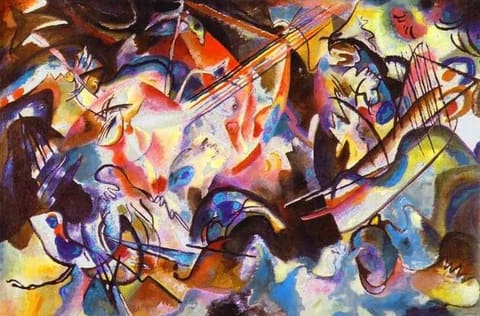 Composition VISwirling masses of color collide across Kandinsky's large Composition VI, an abstract storm he connected with the theme of the biblical Flood.
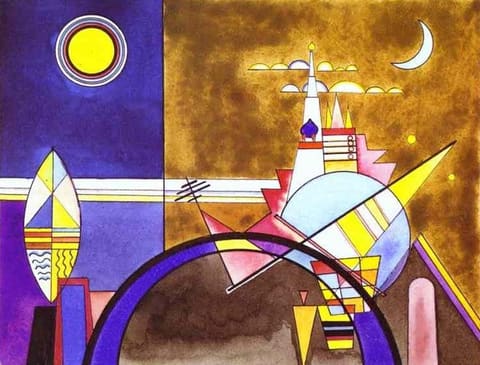 The Great Gate of KievA full yellow sun, a crescent moon and a pink-and-white tower crowd this bright watercolor design built from arcs, wedges and stripes.
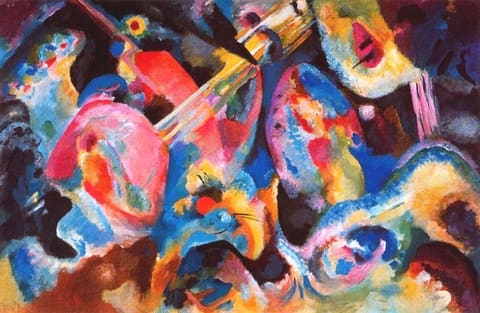 Improvisation DelugeSwirling masses of pink, blue and yellow collide across a dark ground in Kandinsky's abstract meditation on the theme of the flood.
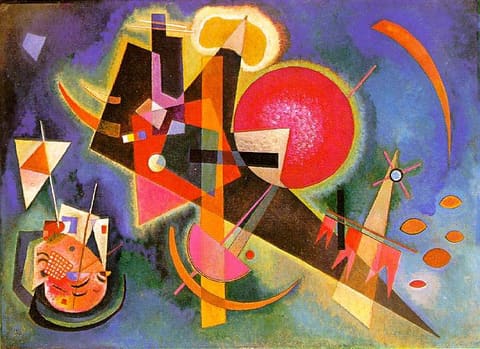 In BlueTriangles, circles and crescents float against a deep blue field in Kandinsky's crisp, geometric abstraction from his Bauhaus years.
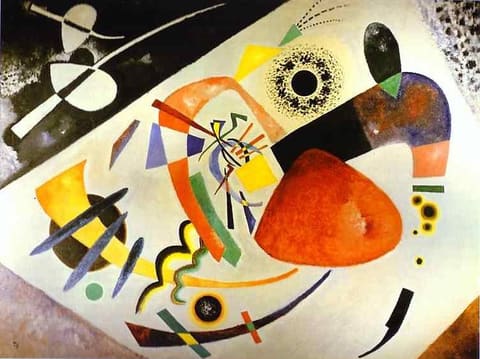 Red Spot IIKandinsky floats a large red-orange shape, arcs, blades and small circles across a tilted white plane set against darker corners.