The Water Lily Pond
You haven't painted this one yet.
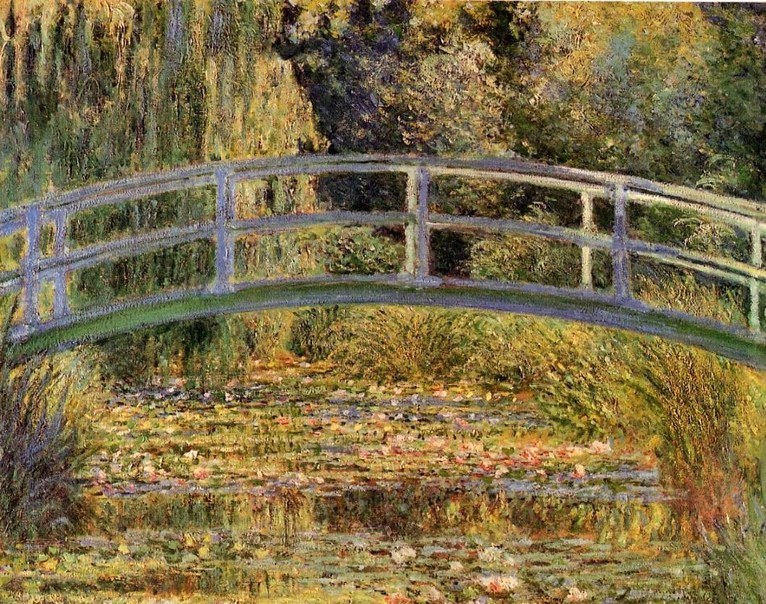
Paint it from memory firstA pale arched footbridge spans a pond crowded with lily pads, framed by dense, glowing foliage in Monet's garden at Giverny.
A gently curving wooden bridge crosses the canvas from edge to edge, its railings picked out in pale gray-green. Beneath it, the pond is crowded with flat lily pads and small pink and white flowers, which shrink as they recede toward the shadowy bank. Behind the bridge, willows and thick plantings fill the upper half with vertical strokes of green, yellow and ochre, leaving almost no sky visible.
Monet designed this garden himself at his home in Giverny, northwest of Paris, diverting water to create the pond and building a Japanese-style footbridge across it. Around 1899 and 1900 he painted the bridge many times from nearly the same spot, studying how changing light altered its colors. These pictures mark the start of a long obsession: in the decades that followed he painted the pond's surface again and again, eventually leaving the bridge and shoreline out entirely.
Notice how the bridge is cut off at both sides, which makes it feel close and immersive, and how the lily pads are laid on in short horizontal dabs that flatten as they near the far bank.
More by Claude Monet
- Paint it to unveilImpression, SunriseA small red sun burns through blue morning haze over a working harbor, its reflection broken into quick orange strokes on the water.
 ChrysanthemumsMonet fills the entire canvas with chrysanthemum blossoms in yellow, pink, red and white, with no vase, table or horizon in sight.
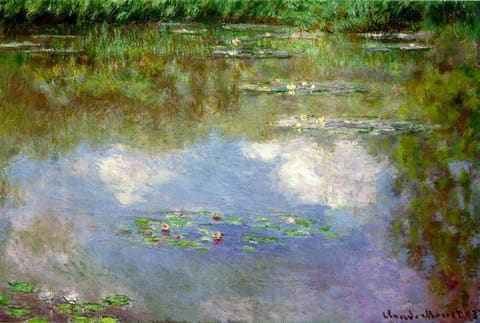 Water LiliesClouds reflected in Monet's lily pond float through the water like a second sky, with clusters of pads and pink blossoms drifting across them.