The Turning Road, L'Estaque
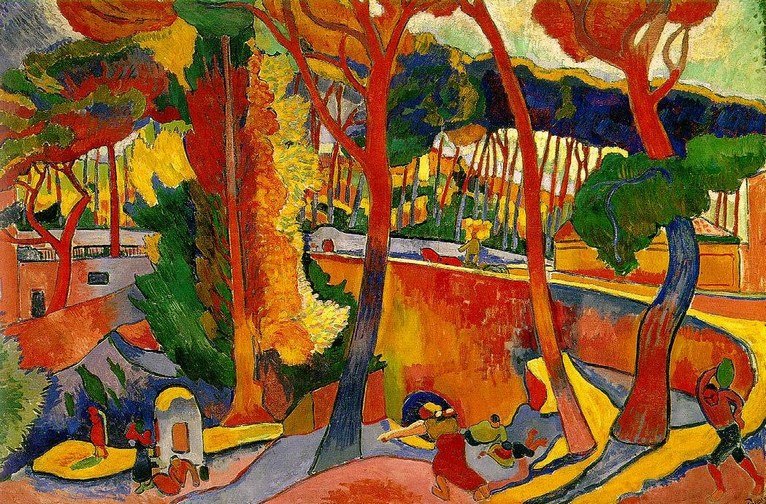
Trees blaze red, orange and blue along a winding road in southern France, where small figures walk beneath a canopy of electric color.
A road curves through the foreground and around a bend, lined by tall trees with red and blue trunks. Beyond a long orange wall, more trees fade back toward a deep blue ridge, and at the far right a bright yellow path disappears behind a green-topped tree. Tiny figures, some carrying bundles, move along the lower edge, and a small white structure stands at the left.
André Derain painted this in 1906 at L'Estaque, the fishing village near Marseille where Cézanne had worked before him. A year earlier, Derain and Matisse had startled the Paris public with pictures in such unnatural colors that a critic dubbed them Fauves, or wild beasts. Here that freedom is in full swing: color is chosen for its force and harmony rather than to describe what the trees actually looked like.
Look at the strong diagonals of the trunks and how they lean in different directions, giving the picture a swaying rhythm. Notice, too, the curved yellow band that traces the road's sweep along the right side.
More by André Derain
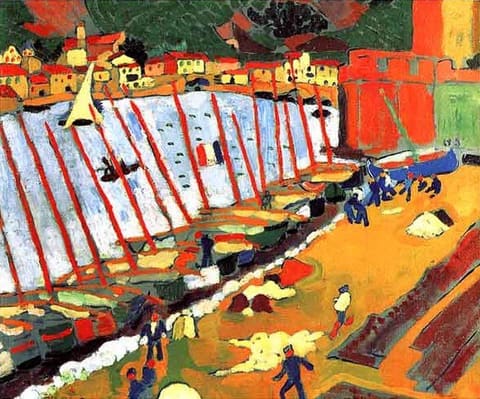 Drying the SailsLong pale sails spread out on the shore at Collioure, crossed by bright red poles, turn a working harbor into a blaze of Fauvist color.
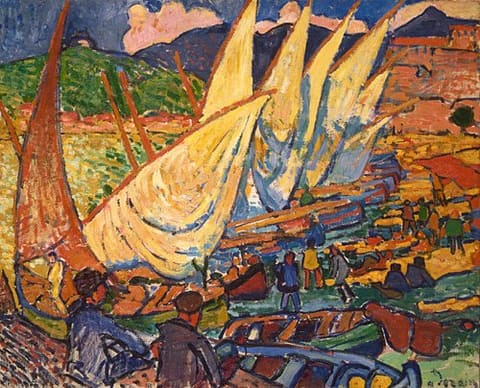 Fishing Boats, CollioureTall yellow and white sails crowd a Collioure beach where fishermen gather, painted by Derain in the summer Fauvism was born.
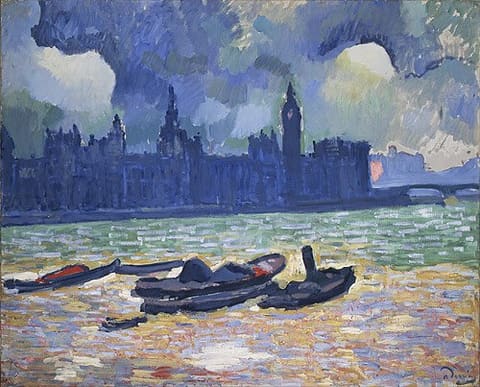 Houses of Parliament at NightWestminster's towers stand as a blue silhouette above a Thames rippling with dashes of green, yellow and pink in Derain's London view.
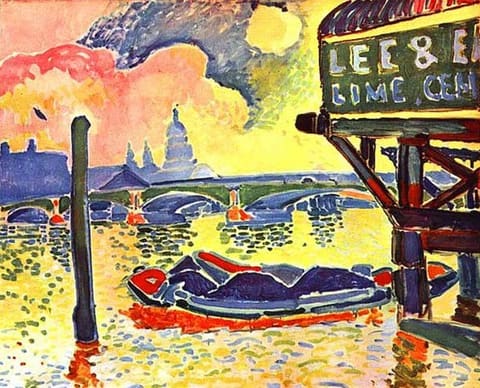 Blackfriars BridgeDerain paints the Thames in blazing yellows, pinks and blues, with a low bridge and a distant dome behind a moored barge.