The Messenger of Autumn
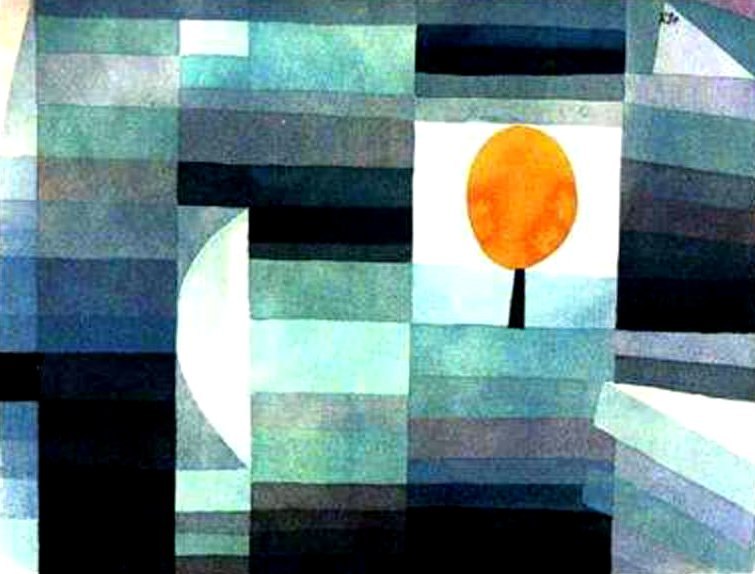
Klee stacks translucent bands of gray, teal and blue, with a single orange disc on a dark stem glowing in a white window.
The picture is built from horizontal strips of color arranged in vertical columns, like a wall of stacked tiles, shading from pale gray-green to deep blue-black. Near the upper right, one panel opens into a white space where a round orange shape sits on a short black stem, like a lone tree or a piece of fruit. At left, a pale crescent curves out of the bands, and at lower right a slanting white wedge breaks the grid.
Klee made this in 1922, while teaching at the Bauhaus, where he developed his ideas about color, rhythm and gradation. By layering thin washes so that each band is a little darker or lighter than its neighbor, he created a quiet scale of tones that works almost like music. The single warm orange among all the cool grays can be read as the messenger of the title, a hint of autumn arriving in a dim, chilly world.
When recreating it, count the columns and keep the darkest bands low and at the left. The orange disc, high and right of center inside its white rectangle, is the detail everyone remembers.
More by Paul Klee
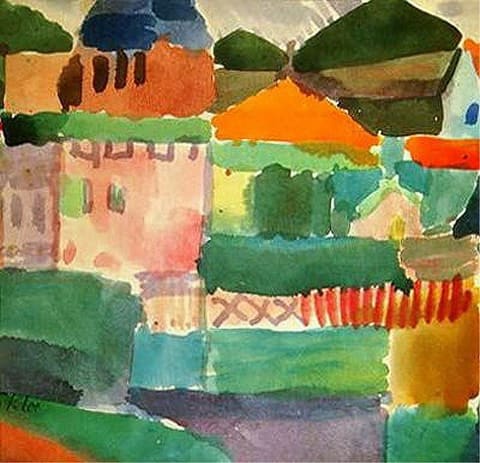 In the Houses of Saint-GermainBlocks of watercolor in orange, green, pink and turquoise stack up like a quilt to suggest houses, roofs and gardens in a North African town.
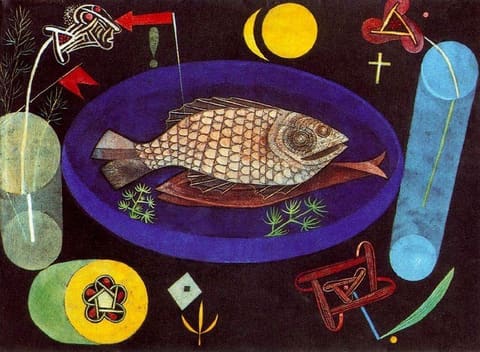 Around the FishA scaly fish lies on a blue platter at the center of a black field, surrounded by floating signs, a moon, a cross and a strange head.