The Dance of Life
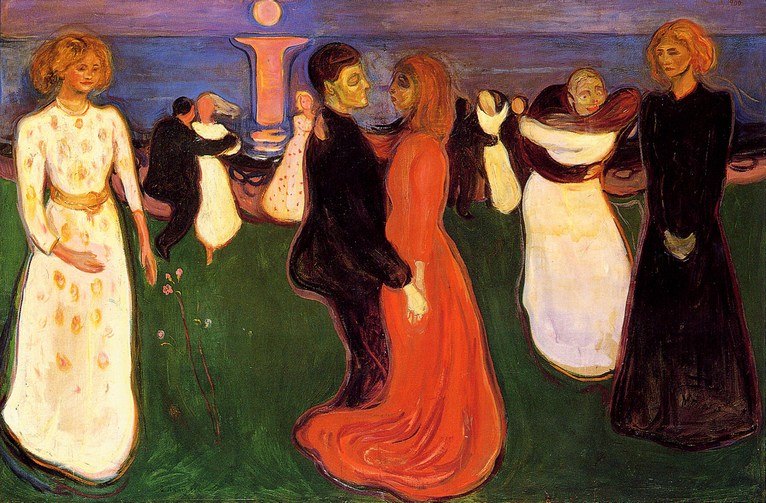
Couples dance on a moonlit shore while a young woman in white and an older woman in black watch from either side, in Munch's meditation on love.
On a green meadow by the sea, a man in black dances with a woman in a flowing red dress at the center, their faces close and tense. To the left stands a fair-haired young woman in a white dress dotted with flowers, smiling and reaching toward a bloom. To the right, a woman in black stands with folded hands, watching. Behind them other couples whirl, and the moon casts a column of light on the water.
Munch painted this in 1899 and 1900 as part of his Frieze of Life, a series of works exploring love, anxiety and death. The three women are often read as stages of a woman's life, or of love itself: hope, passion and loss. Their dresses in white, red and black carry that meaning more clearly than any gesture. The flattened forms and long, flowing outlines reflect the Symbolist and Art Nouveau currents of the time.
Look for the red dress wrapping around the man's legs, as if drawing him in, and the moon's reflection, which forms a shape like a pillar at the top center. That pale column is a recurring motif in Munch's coastal scenes.
More by Edvard Munch
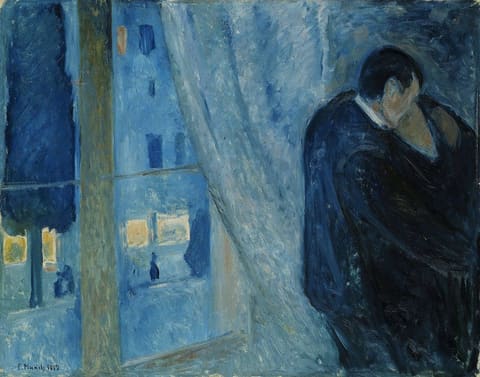 Kiss by the WindowA couple melts into a single dark shape beside a curtained window, while the blue evening street outside glows with a few lit windows.
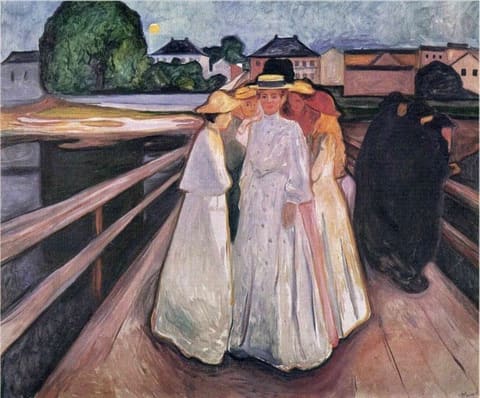 The Ladies on the BridgeWomen in white dresses and straw hats gather on a wooden bridge on a pale summer evening, while dark-clad figures stand apart.
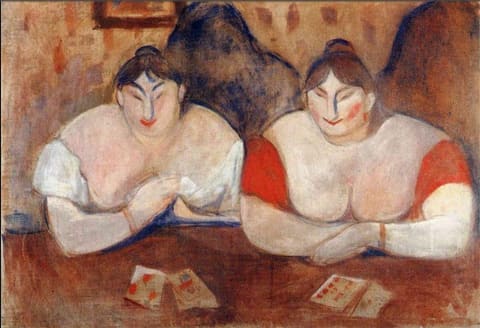 Rose and AmélieTwo women lean on a table over their playing cards, painted by Munch in broad strokes of red, brown and pale flesh tones.
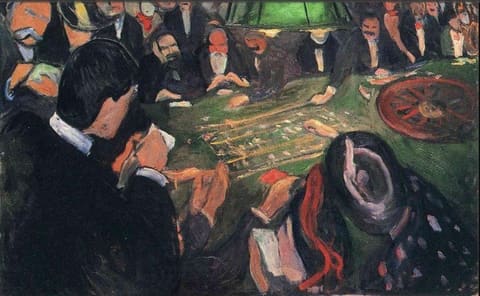 At the Roulette Table in Monte CarloMunch looks down on a crowded roulette table, where hunched gamblers in dark clothes lean over green felt and a red spinning wheel.