Portrait of Adele Bloch-Bauer I
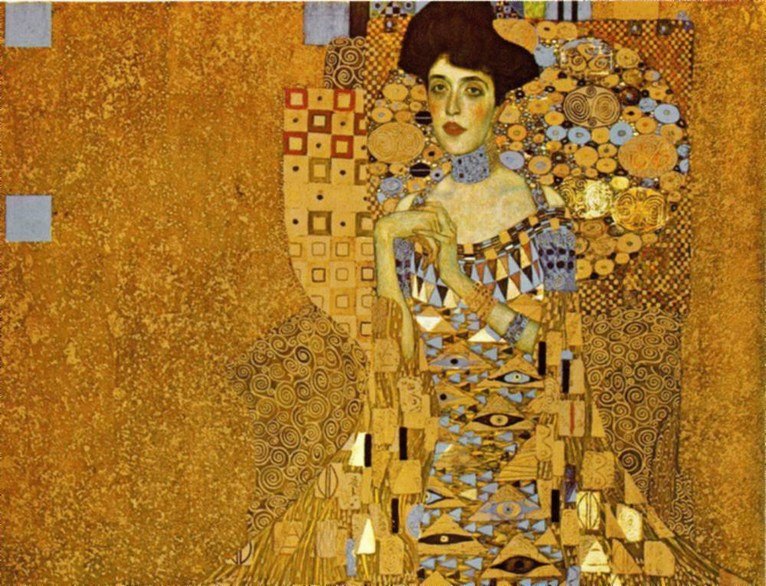
Klimt's golden portrait sets Adele Bloch-Bauer's pale face and clasped hands amid a dazzling field of spirals, eyes and checkerboard patterns.
Only the face, shoulders and hands of the sitter are painted in a lifelike way. Everything else dissolves into ornament: her dress is a cascade of gold triangles and almond-shaped eye motifs, while the chair and background behind her are covered with spirals, discs and checkered squares. She sits slightly turned, her dark hair piled high, her fingers knotted together at her chest in a tense, elegant gesture.
This portrait belongs to Klimt's so-called Golden Period, when he used real gold and silver leaf alongside oil paint, inspired in part by the Byzantine mosaics he had seen in Italy. Adele Bloch-Bauer was the wife of a wealthy Viennese industrialist, and this is the first of two portraits Klimt made of her. Taken by the Nazis, it was returned to her heirs in 2006 after a long legal fight and now hangs at the Neue Galerie in New York.
Look for the small pale blue squares floating in the gold at left and top, the jeweled choker at her neck, and the staring eye shapes running down her dress.
More by Gustav Klimt
- Paint it to unveilThe Tree of LifeA golden tree unfurls in dozens of spiraling branches between a standing woman and an embracing couple, in Klimt's richly patterned design.
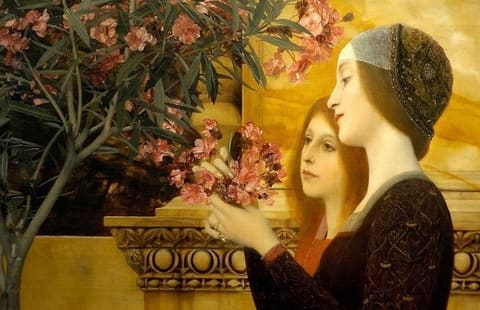 Two Girls with an OleanderTwo young women in historical dress admire a branch of pink oleander beside a carved stone balustrade in Klimt's early, polished style.
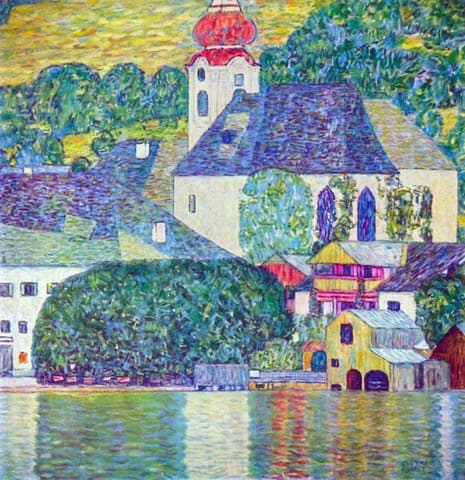 Church in Unterach on the AtterseeThe onion-domed church of Unterach and its crowded houses rise above the still water of the Attersee in Klimt's square, mosaic-like landscape.